

In the mid-19th century, Manchester was a city buzzing with industrial activity. Its skyline was dominated by the towering chimneys of cotton factories. Among the many industrial enterprises of the time, the company “Tootal Broadhurst Lee” stood out. One of its founders, Robert Scott, was a prominent industrialist who helped shape 19th-century Manchester. Learn more about his life, activities, and the company’s success in this article on manchester1.one.
Who Was Robert Scott?
Robert Scott was born in 1822 in Manchester. He did not come from a wealthy family of entrepreneurs or merchants; he built his career entirely on his own. His father was a simple local farmer. Unfortunately, history does not provide much detail about Robert’s early life and career. It is known only that by the 1840s, he worked as an ordinary salesperson in Manchester.
Scott was an early example of a successful manager in the textile industry, achieving significant wealth within one of the era’s largest companies without being either an independent entrepreneur or coming from a textile family.
Business Partnership and the Founding of “Tootal Broadhurst Lee”
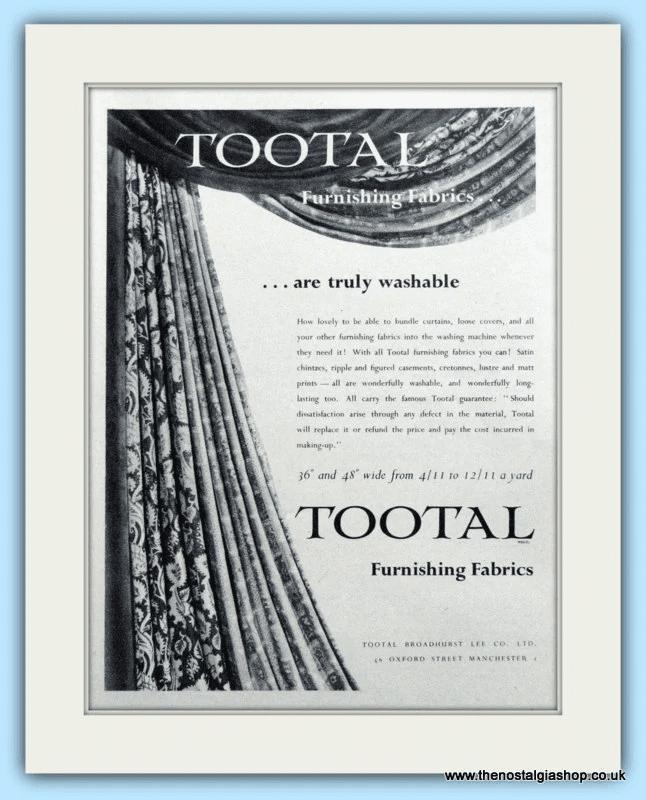
Robert’s life took a significant turn in the 1880s when he became a business partner of local cotton manufacturers Henry Tootal Broadhurst, Henry Lee, and Joseph Lee. Together, they established the innovative vertically integrated company “Tootal Broadhurst Lee,” which combined weaving and spinning—an uncommon practice for the time.
However, the origins of “Tootal Broadhurst Lee” date back even further. Historical records trace the textile company’s roots to 1799, when it was founded by Robert Gardner, a textile trader. Over the decades, the company underwent numerous reorganizations and mergers before being restructured again in 1880 under its new owners, including Robert Scott.
In addition to its dual-specialization focus—innovative for the 19th century—the company also stood out for its extensive marketing network. This network included warehouses and offices not only in Manchester but also in Bradford, Belfast, and even Paris. By the end of the 19th century, “Tootal Broadhurst Lee” employed approximately 5,000 people and operated 172,000 spindles and 3,500 looms. With such scale and production capacity, it became the third-largest vertically integrated cotton production company in the region.
Growth and Success of “Tootal Broadhurst Lee”
Under Robert Scott’s leadership in financial management, the success of “Tootal Broadhurst Lee” was undeniable. By the late 19th century, the company was one of the region’s largest cotton producers. Scott and his partners developed a forward-thinking business model that proved highly effective.
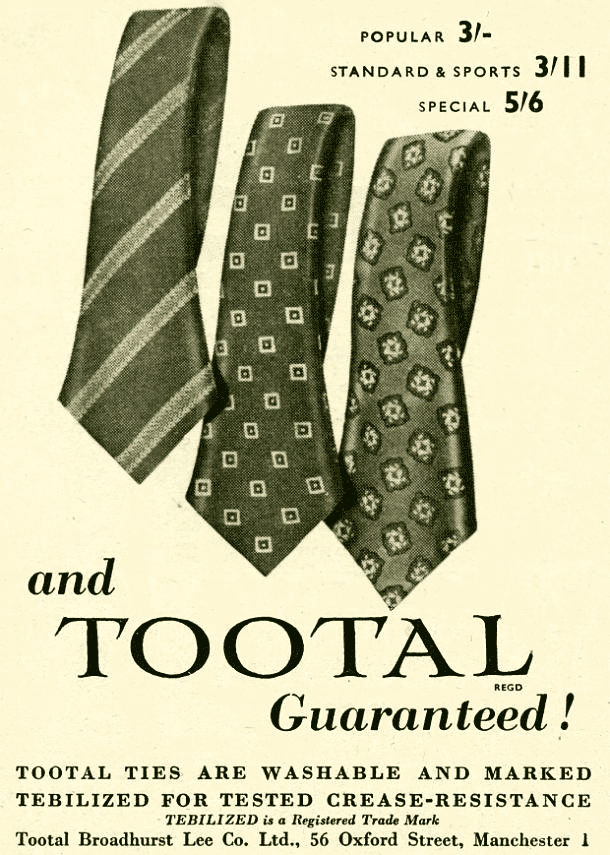
Although Robert Scott passed away in 1904, and his co-founders followed soon after, “Tootal Broadhurst Lee” continued to thrive. By 1918, the company was innovating and expanding further. A research department was established to develop wrinkle-resistant fabrics. In the first half of the 20th century, “Tootal Broadhurst Lee” became even more prominent, thanks to the use of trademarks and its leadership in direct sales to retailers.
Before World War II, the company was among the largest in the region, operating spinning, weaving, and dyeing factories in Bolton, Newton Heath, and Manchester. It produced silk, wool, handkerchiefs, and ties. “Tootal Broadhurst Lee” also expanded its market reach, opening branches in Belfast, Birmingham, Leeds, London, and Glasgow. International branches were established in Argentina, Australia, Canada, France, and New Zealand. After the war, the company opened a new factory in Tasmania.
In the second half of the 20th century, “Tootal Broadhurst Lee” underwent numerous mergers and reorganizations until it was fully acquired by “Coats Viyella” in 1991. In the 21st century, the company remains a clothing manufacturer in Manchester with a rich history and a storied reputation.
The company faced significant challenges on its path to success. The cotton industry was notoriously volatile, subject to the whims of global markets and political events. During these turbulent periods, many Manchester factories closed, leaving thousands unemployed. However, “Tootal Broadhurst Lee” managed to survive all the crises of the past and not only maintained but expanded its cotton production.